
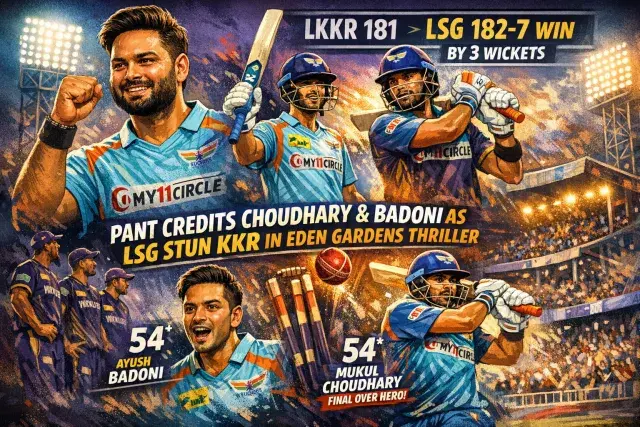
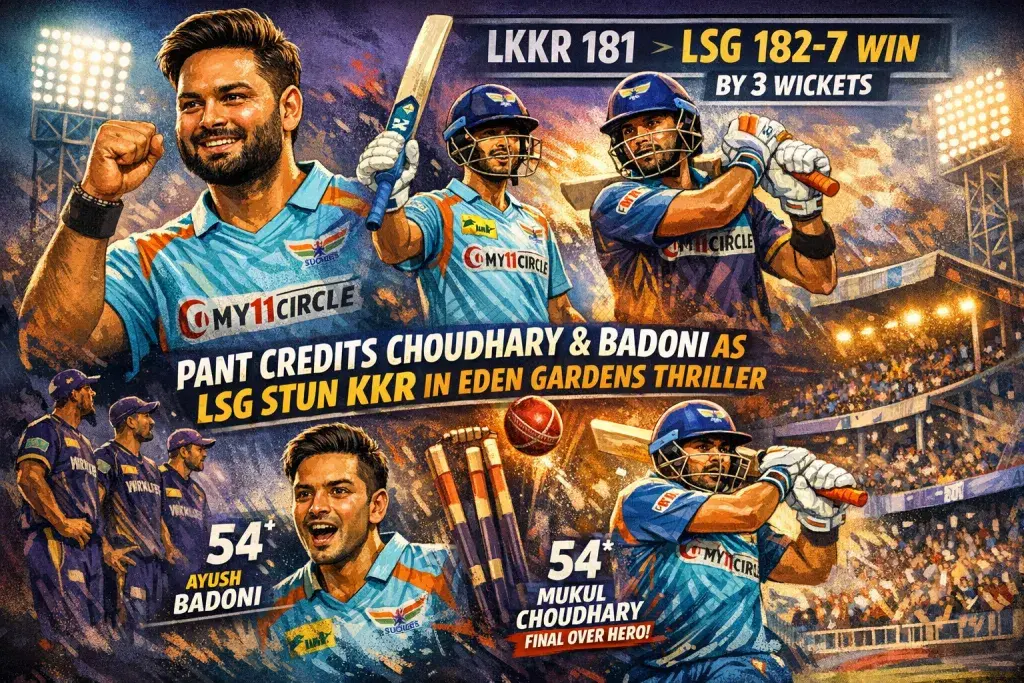
A last-ball, three-wicket win at Eden Gardens handed Lucknow Super Giants a result that their captain Rishabh Pant described in terms of trust and collective belief rather than individual brilliance. Chasing 182, LSG reached their target through a remarkable lower-order effort anchored by Ayush Badoni's 54 and Mukul Choudhary's unbeaten 54, with Choudhary's explosive finishing in the final over sealing the outcome. The victory, coming against three-time IPL champions Kolkata Knight Riders, carried weight beyond the result itself.
Pant's Philosophy: Belief as a Tactical Tool
Post-match, Pant was measured but pointed in how he framed the win. "I do not have words to describe but what a fantastic effort. One thing I made sure of personally is trust, and when you believe in someone, a player can do wonders," he said during the presentation ceremony. The language was deliberate. Pant, who has long emphasised culture-building over individual performance metrics, used the occasion to signal something larger — that LSG's identity is being constructed match by match. "The character, with each and every match like this, shows something is building. We don't want to talk much about it, but something is cooking inside," he added.
This framing matters because it reflects a broader shift in how franchise leadership in high-pressure professional cricket operates. The most effective captains in modern high-stakes formats increasingly function as environment architects — their primary role being to create conditions where less-experienced individuals perform without the paralysis of expectation. Pant's public acknowledgment of Choudhary, a young lower-order contributor, is not incidental. It is institutional reinforcement.
Choudhary and the Record-Breaking Lower-Order Stand
Mukul Choudhary's unbeaten 54 came in circumstances that would have unsettled most batters. With the asking rate climbing and wickets falling, he combined with Avesh Khan in what CricViz identified as the highest partnership for the eighth wicket or lower in a successful IPL run-chase. Choudhary contributed 52 of those 54 runs, while Avesh Khan remained unbeaten on 1 off three deliveries — a detail that underscores just how singularly demanding Choudhary's role was in the closing stages.
Such performances by lower-order batters in high-pressure chases are statistically rare in Twenty20 formats, where the structural expectation is that the top and middle order absorbs the burden. When the formula inverts — when the eighth-wicket partnership becomes the defining moment — it tends to reflect both individual composure and a team environment that has, over time, equipped those batters to function under pressure.
Badoni's Evolution and Shami's Enduring Value
Pant was equally direct about Ayush Badoni, framing his 54-run contribution not as a surprise but as an expectation fulfilled. "He is now a senior pro in our team. That is the role we have given him. In a situation like his, when we talk about Badoni, these are the kind of contributions you want to see from him," Pant said. The distinction is important: describing a 54-run innings under pressure as something that was anticipated, not celebrated as an outlier, communicates to both the individual and the wider group what the standard is.
Pant also addressed Mohammed Shami's contribution to the bowling effort with characteristic candour. "He is not getting any younger, but the experience he brings to the side is invaluable. Having someone like him is amazing. The whole bowling unit is doing an amazing job," he noted. Shami's career has been defined by sustained effectiveness across formats at the highest level, and his presence in a young bowling group carries a form of institutional knowledge that cannot be replicated through training alone.
KKR's 181 and the Margin That Almost Held
Kolkata Knight Riders had posted 181/4, built on contributions from Ajinkya Rahane with 41, Angkrish Raghuvanshi with 45, and a late acceleration from Rovman Powell and Cameron Green. It was a total that, on a surface like Eden Gardens and against a side that had experienced significant top-order pressure during the chase, should have been sufficient. That it was not — and that the deficit was closed by the eighth-wicket stand — speaks to the unpredictability that makes the final overs of a close run-chase among the most analytically difficult passages of play in professional cricket to model or predict.
For LSG, the result arrives at a moment when the franchise is still defining its identity under Pant's leadership. The captain's post-match language — deliberate, internal, process-oriented — suggests that the result is being read within the group not as a culmination but as confirmation of a direction. Whether that direction holds across the remainder of IPL 2026 will depend on whether these kinds of performances remain the expectation, rather than the exception.