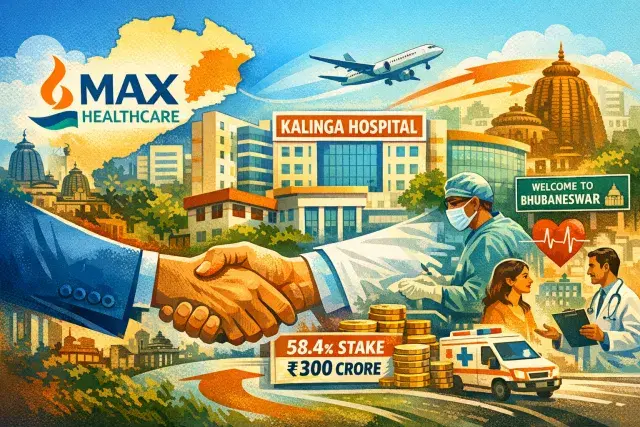
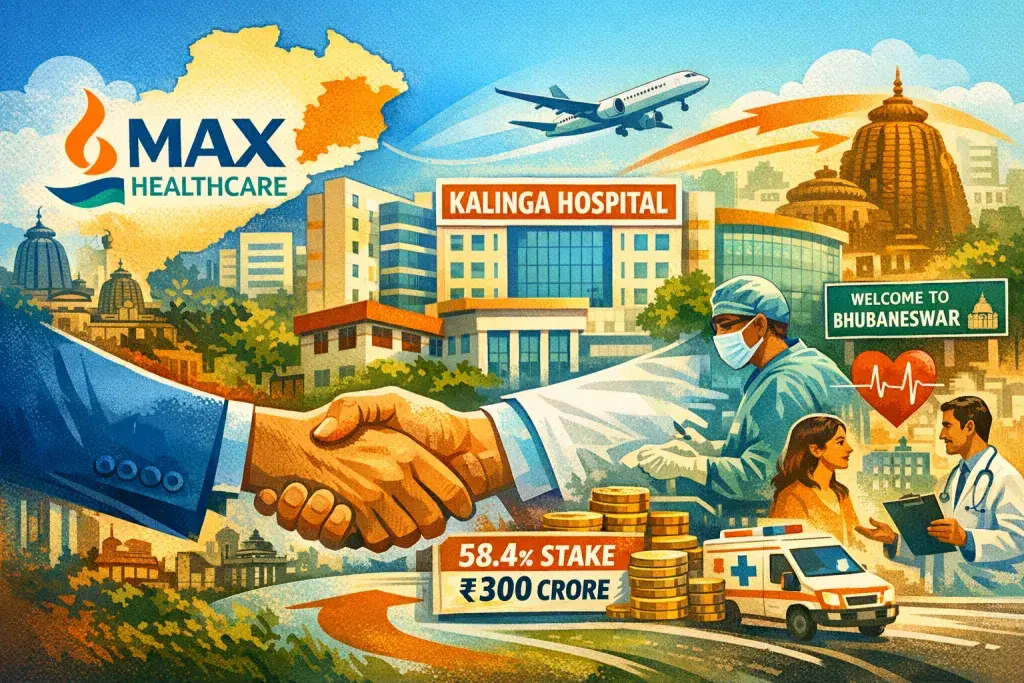
Max Healthcare Institute Ltd has agreed to acquire a 58.4 per cent controlling stake in Kalinga Hospital Ltd (KHL), a 250-bed super speciality facility in Bhubaneswar, for an equity value of INR 300 crore, including a control premium. The seller is Hospital Corporation of Orissa Inc. The acquisition marks Max Healthcare's first entry into Odisha and extends its presence further into eastern India, a region where demand for organised, accredited hospital care has been growing steadily against a backdrop of historically limited supply.
What Max Healthcare Is Buying — and Why It Matters
Kalinga Hospital has been operational since 1997, making it one of Bhubaneswar's more established private healthcare institutions. It holds accreditation from the National Accreditation Board for Hospitals (NABH), a certification that signals compliance with defined quality and safety standards — a baseline that large hospital groups typically require before integration into their networks.
The hospital operates across several high-acuity specialities: neuro sciences, cardiology, orthopaedics, gastroenterology, medical oncology, and renal sciences. These are precisely the disciplines where patients in Tier 2 and emerging Tier 1 cities most often travel to metros for treatment, incurring significant cost and disruption. Establishing credible capacity in these areas locally addresses a genuine gap.
The physical asset is equally significant. The campus sits on a 10-acre land parcel in Maitri Vihar, Bhubaneswar, with a built-up area of approximately 2,60,000 sq ft. Current bed capacity stands at 250, but the site has the potential to scale beyond 1,000 beds — giving Max Healthcare room to expand in phases as patient volumes and clinical demand justify the investment. That kind of long-term optionality on land in a state capital is rarely available through greenfield development at comparable cost or speed.
The Strategic Logic Behind Bhubaneswar
Bhubaneswar has seen sustained economic and infrastructure development over the past decade. As Odisha's capital and its largest city, it functions as the primary referral destination for patients across the state and, to a degree, from neighbouring states. Yet organised, branded hospital capacity in the city has remained limited relative to comparable state capitals in southern or western India.
For Max Healthcare, which has built its network primarily in Delhi-NCR and Punjab, moving into eastern India represents both a diversification of geographic risk and an attempt to capture markets before competition intensifies. Acquisitions of established, accredited hospitals — rather than building from scratch — allow the group to generate revenue faster while inheriting an existing patient base, clinical workforce, and operational infrastructure.
Abhay Soi, Chairman and Managing Director of Max Healthcare Institute, described the acquisition as a step toward extending quality healthcare services to a fast-growing region, consistent with the company's stated strategy of building a presence across key urban centres beyond its core markets.
Acquisition as Expansion Model — Risks and Expectations
Max Healthcare has pursued a deliberate mix of acquisitions and brownfield developments in recent years. This approach reflects a broader pattern across India's private hospital sector, where organic greenfield growth is slow, capital-intensive, and subject to lengthy gestation periods before reaching operational viability.
Acquiring a hospital with nearly three decades of clinical history carries its own set of challenges. Integration — of clinical protocols, staff culture, billing systems, and brand standards — is rarely straightforward. The gap between what an accredited hospital looks like on paper and what it delivers consistently in practice can be significant. Max Healthcare's ability to close that gap will determine whether Kalinga Hospital becomes a genuine asset or an operational burden during the transition period.
The transaction remains subject to customary conditions precedent as outlined in the share purchase agreement, meaning formal completion depends on regulatory and contractual clearances. Once concluded, the deal will give Max Healthcare a platform in one of India's less penetrated private healthcare markets — with the infrastructure already in place to grow substantially from its current 250-bed base.